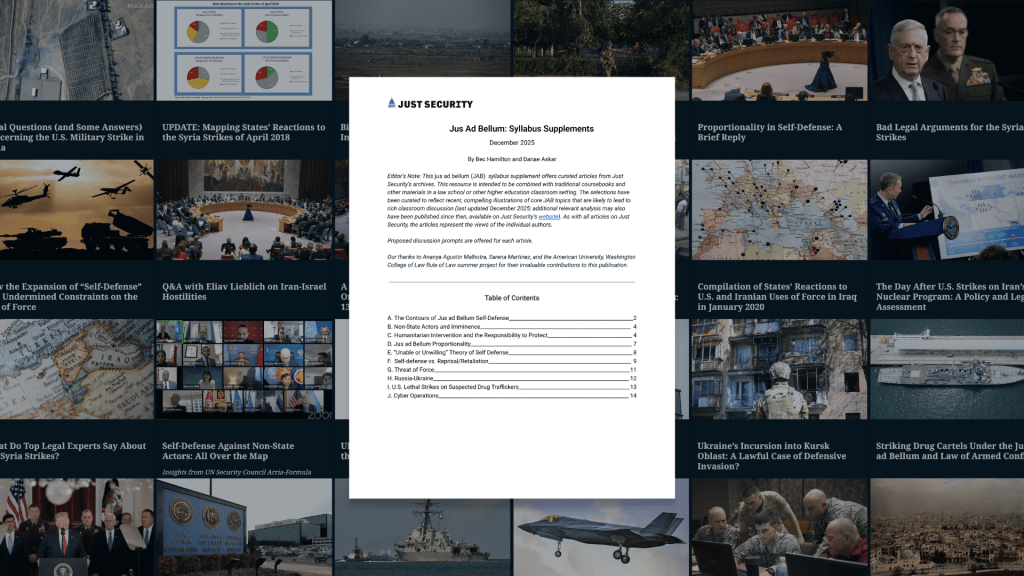
Access the Jus Ad Bellum / Use of Force Syllabus Supplement via PDF here. (Readers may also be interested in the International Humanitarian Law / Law of Armed Conflict Syllabus Supplements)
Table of Contents
A. The Contours of Jus ad Bellum Self-Defense
B. Non-State Actors and Imminence
C. Humanitarian Intervention and the Responsibility to Protect
D. Jus ad Bellum Proportionality
E. “Unable or Unwilling” Theory of Self Defense
F. Self-defense vs. Reprisal/Retaliation
I. U.S. Lethal Strikes on Suspected Drug Traffickers
A. The Contours of Jus ad Bellum Self-Defense
1. Brianna Rosen, Tess Bridgeman, and Nima Gerami, The Day After U.S. Strikes on Iran’s Nuclear Program: A Policy and Legal Assessment (June 2025)
Discussion prompts:
i. In your view, did the June 21 strikes on Iran’s Fordow, Natanz, and Esfahan nuclear sites meet the international law requirements of imminence, necessity, and proportionality, or do they constitute preventive force prohibited by the United Nations Charter and customary international law? How should decision-makers distinguish legitimate self-defense from prevention when dealing with nuclear latency and ambiguous intelligence? Why would having a weapons capability, but not a specific intention to use it, be insufficient to justify an invocation of self-defense?
ii. Do such attacks deter future nuclear proliferation or undermine the Nuclear Non-Proliferation Treaty (NPT) by discouraging cooperation with the International Atomic Energy Agency (IAEA) and normalizing force against nuclear infrastructure? If you were advising Congress or the National Security Council, what mix of legal authorization to use force, diplomatic engagement, and verification mechanisms would you recommend to best balance deterrence, escalation control, and the integrity of the global nonproliferation regime?
2. Adil Haque, Indefensible: Israel’s Unlawful Attack on Iran (June 2025); and Amichai Cohen and Yuval Shany, A New War or a New Stage in an Ongoing War – Observations on June 13 Israeli Attack against Iran (June 2025)
Discussion prompts:
i. What evidence should States invoke to demonstrate an “imminent armed attack” that meets the threshold to invoke article 51 self-defense measures under the United Nations Charter? In the specific context of the June 2025 Israeli strikes on Iran, what specific factors would need to be present for those strikes to be permissible under international law?
ii. Can you articulate the difference between an “armed attack” and an “armed conflict” under international law? What would it mean if the type of use of force in self-defense that Israel engaged in targeting Iran’s nuclear program were permissible at any point during an ongoing armed conflict, regardless of the imminence of an armed attack stemming from the nuclear program? What are the tradeoffs of the approach articulated by the author, such as to utilize lulls in fighting to settle disputes and/or invite the U.N. Security Council to take measures to maintain international peace and security?
iii. What do you make of the “ongoing armed conflict framework” and its application to the June 2025 Israeli attack on Iran? Do you think Israeli government lawyers were more likely to have made a preemptive strike argument with reference to Article 51 of the United Nations Charter, or an “ongoing armed conflict” argument? Based on an application of both the law and the facts of this particular context, which do you think would be the stronger argument for those lawyers to make on behalf of their government? Why? What if the argument were “ongoing armed attack” instead?
3. Oona Hathaway, How the Expansion of “Self Defense” Has Undermined Constraints on the Use of Force (September 2023)
Discussion prompts:
i. What are the primary self-defense theories identified by the author, and how have they contributed to an expansionist approach to self-defense under international law? Evaluate the “preemptive self-defense” framework set forth by the United States. Consider, too, the Bethlehem Principles, regarding self-defense against armed attacks by non-State actors. What are the strongest arguments in support of, and against, these positions?
4. Mehrnusch Anssari and Benjamin Nußberger, Compilation of States’ Reactions to U.S. and Iranian Uses of Force in Iraq in January 2020 (January 2020)
Discussion prompts:
i. If international law speaks through States, what do you think we should make of strategic silence in this case? When might a State choose to refrain from taking a public position, and why? Does this communicate anything significant about international law and how it is formed, in your view?
ii. What do you make of the authors’ questions regarding how to assess the legal relevance of certain statements, particularly those that avoid explicit reference to the law, that are ambiguous as to their support for an action, or that express understanding for another State’s actions without invoking legal language? In your view, with particular consideration for the formation of customary international law, what must a State’s official statement do (or not do) in order to constitute a clear legal position?
B. Non-State Actors and Imminence
1. Adil Ahmad Haque, Self-Defense Against Non-State Actors: All Over the Map (March 2021)
Discussion prompts:
i. If Article 51 permits self-defense against only State armed attacks, what — if anything — could legitimately extend the doctrine to non-State actors without territorial State consent? Evaluate three candidates: (a) the unwilling or unable doctrine as a customary rule; (b) an imminence-anchored first-strike theory with strict sunset/verification; and (c) a narrow “quasi-State” exception for entities like ISIL. For each, specify any administrable elements (attribution/threshold of violence, evidentiary standards, geographic limits, temporal limits, reporting to the Security Council) that would prevent a slide beyond imminence and guard against potential abuse.
ii. The article identifies the United States as a potential outlier on four axes (imminence, continuation of force post-attack, origin-of-attack requirement, and breadth of “armed attack”). Choose one axis and make an argument for either convergence (tightening U.S. practice to the Netherlands/UK model), or principled divergence. What concrete rule text would you write (e.g., an updated Article 51 letter template or coalition rules of engagement) to lock in your choice? How would your approach handle: (1) clear cessation vs. “temporary lull”; (2) host-State consent refusals; and (3) documentation burdens to satisfy skeptical third States?
C. Humanitarian Intervention and the Responsibility to Protect
1. Alonso Gurmendi Dunkelberg, Rebecca Ingber, Priya Pillai and Elvina Pothelet, UPDATE: Mapping States’ Reactions to the Syria Strikes of April 2018 (May 2018)
Discussion prompts:
i. When States politically support another State’s strike but avoid overtly declaring it lawful, should political statements of support constitute evidence of opinio juris in the context of the formation of customary international law — or should they have no bearing on customary interpretation of the legal norm? What indicators best distinguish a political statement from a legal statement?
2. Jack Goldsmith and Oona Hathaway, Bad Legal Arguments for the Syria Strikes (April 2018)
Discussion prompts:
i. In your opinion, are there any circumstances in which States should be allowed to use force to enforce international prohibitions like the chemical weapons ban, even without consent or United Nations Security Council authorization? Which kinds of international prohibitions, if any, should be subject to such unilateral enforcement, and which shouldn’t? Why? What would be the basis for such action under international law? What do you see as the potential benefits and potential costs of the “illegal but legitimate” argument put forward by France?
3. Just Security, What Do Top Legal Experts Say About the Syria Strikes? (April 2017)
Discussion prompts:
i. If the United Nations Charter’s black-letter rules render the Syria strike unlawful, should the United States nonetheless advance a narrow humanitarian-intervention theory — or embrace an “illegal but legitimate” posture? Compare the systemic costs/benefits of each path: precedent-setting, reciprocity risks, coalition politics, and effects on future crises (chemical weapons, mass atrocities). Are there any guardrails (criteria, process, reporting) that would make any humanitarian intervention theory minimally acceptable?
4. David Kaye, Harold Koh’s Case for Humanitarian Intervention (October 2013)
Discussion prompts:
i. When fundamental human rights aims collide with the United Nations Charter’s allocation of authority for the use of force (for instance under Art. 2(4), Ch. VII, the Security Council veto), which should control as a matter of law? As a matter of morality? How does fidelity to law enhance or erode the morality of a use of force decision in this context? If you privilege human rights protection, what is a principled reading that keeps the prohibition of the use of force intact without turning it into a policy balancing test? An exception that swallows the rule or is ripe for abuse?
ii. The article indicates that Kosovo provides little legal support for humanitarian intervention because States — especially the U.S. — framed their justification in policy terms and many States rejected the operation’s legality. How should lawyers advise decision-makers when the policy equities (chemical-weapons norms, atrocity prevention, or similar) are strong, but legality is weak? Should governments ever embrace “illegal but legitimate,” or does this risk eroding the value of law and its power to constrain State action across the board? Given the formation of custom requires State practice and opinio juris, what specific State behavior or statements would be required to move humanitarian intervention from a contested policy to lawful norm?
5. Harold Koh, Syria and the Law of Humanitarian Intervention (Part II: International Law and the Way Forward) (October 2013)
Discussion prompts:
i. Koh advocates moving from an “illegal but tolerated” paradigm for humanitarian intervention, to a framework where such intervention is narrowly lawful in extreme cases. His framework relies on an Article 2(4) affirmative defense grounded in United Nations Charter purposes, an exhaustion of Security Council remedies, and strict proportionality. Does formalizing that exception reduce abuse — because it sets conditions for intervening — or increase abuse, by giving powerful States a ready-made script for unauthorized force?
ii. Would you recommend any additional elements, such as some combination of United Nations General Assembly action (for example, “Uniting for Peace”), regional-organization participation, independent findings on the underlying atrocities, or something else?
6. Ryan Goodman, Humanitarian Intervention and Global Legal Norms (October 2013)
Discussion prompts:
i. The article describes a practical space in which humanitarian intervention without United Nations Security Council authorization is still legally prohibited but sometimes tolerated (“illegal but not unprecedented”). In your opinion, does this kind of constructive ambiguity actually protect the Charter’s baseline while allowing rescue in extreme cases, or does it reward powerful States for selective illegality and potentially make it harder to condemn pretextual interventions? Or do you evaluate this paradigm differently than either of these potential views?
ii. If threats of force for humanitarian purposes already receive a de facto “pass,” does this signal that opinio juris is shifting toward a narrow humanitarian exception — or does it instead show that States prefer to manage these cases politically, outside the strict contours of law, precisely to avoid creating doctrine? What would be lost (or gained) by codifying Koh’s “ambulance driver” style exception as compared to keeping the current, practice-driven model?
D. Jus ad Bellum Proportionality
1. Charlie Trumbull, Assessing Jus Ad Bellum Proportionality: A Factored Approach (July 2024); and Adil Ahmad Haque, Enough: Self-Defense and Proportionality in the Israel-Hamas Conflict (November 2023)
Discussion prompts:
i. What is the relationship between proportionality under IHL and proportionality with respect to jus ad bellum claims of self-defense?
ii. If proportionality in jus ad bellum requires weighing anticipated civilian harm against the strategic aims of self-defense when force is used, how does or doesn’t this blur the line between jus ad bellum and jus in bello? If it does blur the line in your view, does such a blur create a more coherent legal framework or, conversely, risk undermining core protections in each body of law? How so?
2. Charles Kels, The Problem of Proportionality: A Response to Adil Haque (November 2023)
Discussion prompts:
i. With consideration for the article’s analysis in mind, what, in your view, is the relationship between what is “ethical and wise” and what is legal in international humanitarian law and jus ad bellum? What should it be?
ii. If Kels is right that “self-defense proportionality is about the strategic scope of the military response” rather than the civilian harm it generates, what does that imply, in your view, for the ability of international law to constrain large-scale defensive wars, from a practical perspective?
3. Adil Ahmad Haque, Proportionality in Self-Defense: A Brief Reply (November 2023)
Discussion prompts:
i. Why might the law use a different assessment for proportionality with respect to jus in bello, as opposed to self-defense? Do you think this distinction in law has value, or do you take issue with this distinction? Why or why not?
ii. What are the different sources of State practice cited in the article, and which is most compelling to you as evidence of customary law? What makes that State practice particularly compelling or less so, in your view?
E. “Unable or Unwilling” Theory of Self Defense
1. Adil Ahmad Haque, Self-Defense Against Self-Defense, In Syria and Beyond (May 2018)
Discussion Prompts:
i. How do you view the concept that there can be “no self-defense against self-defense”? In your opinion, is this a necessary legal principle, or can you articulate a coherent legal order where both an intervening State and the territorial State simultaneously claim self-defense without contradiction? In the Syria tangle identified in the article (U.S. ↔ SDF ↔ Syria ↔ Russia), who, if anyone, do you think forfeits or overrides their self-defense rights, and on what theory (waiver, wrongdoing, lesser-evil, something else)?
ii. If you had to choose one of the three paths for potentially improving the doctrine identified in the article (implicit consent, broader forfeiture via support/omission, and a genuinely impartial “lesser evil” proportionality test), or design a fourth, what do you think a politically realistic and normatively defensible revision of the doctrine would look like, and what costs might it impose on weaker territorial States? How would your preferred approach handle a hypothetical case in which a near-peer power invoked “unwilling or unable” against the United States (e.g., claiming a right to strike a non-State group on U.S. soil over the United States’ objection)?
2. Tess Bridgman, When Does the Legal Basis for U.S. Forces in Syria Expire? (March 2018)
Discussion Prompts:
i. How often must States invoking the unable or unwilling doctrine re-evaluate conditions underlying their claim of lawfully using force within a non-consenting State? In practice, what concrete indicators or “tripwires” would you use to decide that Syria is no longer unable or unwilling — change in territorial control, ISIL’s operational capacity, a competent leader’s offer of consent, or something else? And if the United States doesn’t periodically re-evaluate but rather treats initial necessity as a blank check, does that undermine the doctrine itself, or expose particular uses of it as unlawful extensions?
ii. As a matter of law, where would you draw the line between (a) legitimately staying in Syria until attacks from ISIL in/through Syrian territory are no longer ongoing or imminent, and (b) an overbroad mission that effectively licenses semi-permanent occupation? How do concepts like Luban & Blum’s “morally legitimate bearable risk” inform your thinking about when the United States must accept some residual risk of ISIL resurgence rather than continuing to shift that risk onto Syrian territory and sovereignty?
3. Fionnuala Ni Aolain, International Law a la Carte: Brian Egan’s Jus ad Bellum Doctrine (April 2016)
Discussion prompts:
i. Does the U.S. reliance on “unwilling nor unable” as a basis for self-defense in certain circumstances make future armed conflicts more likely? In what ways? Can you make legal arguments both for and against the validity of such a basis for self-defense? What are the relative weaknesses and strengths of each argument? If you were an attorney advising a policy-maker in a government other than the United States, how would you advise that policy-maker regarding legally-available bases for self-defense?
4. Marty Lederman, President Obama’s Report on the Legal and Policy Frameworks Guiding and Limiting the Use of Military Force (December 2016)
Discussion prompts:
i. How does international law generally formulate the options available to States who have suffered an armed attack from a non-State actor, in situations where the host State is neither complicit in nor responsible for the non-State actor’s armed attack? Can you briefly summarize the preconditions for use of force in this context and how this relates to the “unwilling or unable” doctrine, as articulated in the article?
F. Self-defense vs. Reprisal/Retaliation
1. Eliav Lieblich, Q&A with Eliav Lieblich on Iran-Israel Hostilities (April 2024)
Discussion prompts:
i. How, in practice, should international law draw the line between genuinely preventive self-defense after a pattern of attacks and post-hoc punishment, especially when both sides raise the issue of “restoring deterrence”? If you were drafting reforms to the jus ad bellum standard, what indicators (timing, rhetoric, evidence of future threats, prior exchanges) would you use to decide when a strike is still defensive and when it has slid into an unlawful reprisal? In your view, what are the benefits and potential costs of developing specific criteria along these lines?
ii. In your opinion, should IHL attach to each discrete Iran–Israel exchange to maximize protection and clarify war-crimes liability, or would that potentially risk normalizing and routinizing uses of force that are shaky under jus ad bellum? How would you design a conflict-classification approach that accounts for proxy warfare, long pauses between strikes, and overlapping IHL/IHRL obligations without either under- or over-extending the “armed conflict” frame?
2. Ryan Goodman, Legal Questions (and Some Answers) Concerning the U.S. Military Strike in Syria (March 2021); and Adil Ahmad Haque, Biden’s First Strike and the International Law of Self-Defense (February 2021)
Discussion prompts:
i. Of the analytic tools for assessing the legal justifications offered by the United States for the February strikes in Syria, which do you find the most compelling or unconvincing, and why? If you were a lawyer for the United States, which argument(s) would you gravitate toward, and why? What if you were a lawyer for the United Nations? For the Syrian Arab Republic?
ii. Taking the two articles together, how do you answer the question as to whether international law permits States to take a proportionate military strike against an organized armed group that has subjected the State to a series of armed attacks, and the State has high confidence that such a strike will stop the attacks from continuing? Why? What factors are the most important to your assessment? For instance, how much does frequency of the recurring attacks by the organized armed group matter to your view? What are the strongest counterarguments against your position, and how would you address them?
3. Adil Ahmad Haque, Iran’s Unlawful Reprisal (and Ours) (January 2020)
Discussion prompts:
i. How do you understand the immediacy standard highlighted in the article, both normatively and practically in a world of long-range strikes, dispersed decision-making, and complex threat assessments? How, if at all, should the law distinguish between an impermissible “lesson-teaching” reprisal and a delayed but still genuinely protective strike aimed at neutralizing a real risk of future attacks?
ii. In your opinion, should we understand the pattern of reciprocal violations detailed in the article as evidence that the customary law of self-defense is shifting toward a broader deterrence-based model, or as unlawful practice that other States and scholars ought to resist and treat as non-opinio juris? If the U.N. Security Council is structurally unable to act when its permanent members are involved, what realistic alternatives — regional arrangements, General Assembly action, tighter doctrinal rules, or something else — could channel responses away from cycles of unilateral armed reprisals?
4. Geoffrey Corn & Rache VanLandingham, Lawful Self-Defense vs. Revenge Strikes: Scrutinizing Iran and U.S. Uses of Force under International Law (January 2020).
Discussion prompts:
i. As articulated in the article, what is the difference between lawful self-defense versus retaliation following an armed attack that is not permitted by international law? And, what are the lawfully-permitted options for a State to seek recourse, after a threat has been terminated?
ii. What kinds of evidence do you think would be necessary to establish that a State’s attack was necessary to prevent the imminent use of force by another State, and how might a State substantiate that? Can you think of reasons why a State would withhold its proof that its attack was justified under international law? How could a State balance the call to be forthcoming with evidence to support their legal right to exercise self-defense in a particular instance, and protecting sensitive intelligence or national security equities that might be impacted by such disclosure? If you were legal counsel to a State, how would you advise that the State balance these potentially competing interests?
G. Threat of Force
1. Michael Schmitt, U.S. Saber Rattling and Venezuela: Lawful Show of Force or Unlawful Threat of Force? (November 2025)
Discussion prompts:
i. What is the difference between a “show of force” and an unlawful “threat” of force under international law? What import does each designation have from a legal perspective? What would escalate a show of force into a threat, and what factors must be met in order for a threat to be unlawful? With these factors in mind, how do you evaluate the United States’ actions in relation to Venezuela as described in the article? Do they rise to the level of an unlawful threat of force in violation of Article 2(4) of the United Nations Charter?
H. Russia-Ukraine
1. Chris O’Meara, Ukraine’s Incursion into Kursk Oblast: A Lawful Case of Defensive Invasion? (August 2024)
Discussion prompts:
i. How do you evaluate whether Ukraine’s advances into Russian territory in response to Russia’s war of aggression were lawful under international law? Do you agree that the nature and scale of Russian aggression against Ukraine (and Russian occupation of Ukrainian territory) indicates that Ukrainian incursions into Russian territory meet the requirements of necessity and proportionality under the law governing the right to self-defense? If so, are there any potential slippery-slope consequences of such a position? Conversely, if not, what are the potential consequences of restricting States from making counter-incursions in a context like this? For either position, what incentives (positive or negative) might such an interpretation of the legal framework raise?
i. What are the strategic and political risks for Ukraine if its incursion is viewed as unlawful by the international community? Can you think of any additional factors to complement (or counter) those raised by the author?
2. Dor Hai, A Reply to Chris O’Meara: Necessity and Proportionality in International Law on the Use of Force (August 2024)
Discussion prompts:
i. In your view, why might it be important to distinguish between necessity and proportionality in assessing self-defense under international law? What, if any, are the risks of inadvertently eliding these two concepts?
ii. Consider the two approaches to assessing proportionality raised by the author in this article: the view that self-defense must not be “excessive” when measured against the legitimate defensive purposes (and therefore only permits the halting and repelling of the aggressor’s attacks), and Hai’s articulation that to be proportional, a State’s self-defense should be limited to measures that are proportional to the anticipated value or benefit of repelling the armed attack in question, and other imminent armed attacks. Which of these approaches aligns more closely with your own views, and why? Are there any potential problems or risks with either of these approaches?
I. U.S. Lethal Strikes on Suspected Drug Traffickers
1. Michael Schmitt, Attacking Drug Cartels in the Territory of Another State (October 2025)
Discussion prompts:
i. What do you make of the debate regarding whether a State may exercise the right of self-defense by conducting operations into another State that is “unwilling or unable” to put an end to activities related to an armed attack against the first State? How would you argue in favor of the position that international law permits the right to self-defense to be exercised in such a manner? How would you argue against it?
2. Michael Schmitt, Striking Drug Cartels Under the Jus ad Bellum and Law of Armed Conflict (September 2025)
Discussion prompts:
i. What is the prevailing view of conduct that qualifies as an “armed attack” as that term is understood in international law?
ii. How do you evaluate the legal position a few States have taken that views non-destructive or injurious cyber operations as a use of force potentially rising to the level of an armed attack? Do you agree with States that take this legal position? If you were legal counsel for these States, what arguments might you make to support this position, including (but not limited to) the causal relationship between the cyber operation and the harm caused? If you were arguing against this position, what arguments would you make? What are the potential consequences of a more expansive position regarding what types of actions constitute an armed attack? In your opinion, can this position be distinguished from cartel or criminal gang activities like shipment and sale of illicit drugs?
iii. If you were legal counsel to a State, what position would you take in the debate surrounding the applicability of the right of self-defense to actions by non-State actors like drug cartels, and why? Conversely, if you were an ICJ judge, which arguments for or against such applicability would you find most compelling, and why?
J. Cyber Operations
1. Michael Schmitt, Russia’s SolarWinds Operation and International Law (December 2020)
Discussion prompts:
i. What is your view as to whether a cyber operation that is not destructive nor injurious in its effects constitutes a use of force? Is it important whether there is a permanent loss of functionality of the targeted infrastructure or system(s)? What kinds of harm would need to have been committed to reach the use of force threshold, in your view? If the operation creates a vulnerability that allows a State to access another State’s system and cause damage, but no damage has yet occurred, what is your view on whether the latter State ought to be able to act preventatively to prevent such damage from potentially occurring?
ii. If the operation were to be physical instead of cyber in nature, i.e. (for the sake of this hypothetical), literally installing a “back door” into the Pentagon so that Russia could steal records if it chose, how would you understand that action under international law? Would this constitute an “armed attack” sufficient to trigger the right to self-defense under the U.N. Charter? How does your answer to this question inform your assessment of whether a cyber operation to gain data access ought to be understood under this legal framework?
2. Ryan Goodman, Cyber Operations and the U.S. Definition of “Armed Attack” (March 2018)
Discussion prompts:
i. With particular consideration for the context of cyber operations, is the U.S. approach more or less compelling than a more conservative approach regarding what constitutes an “armed attack,” in your view? Why? What are the primary benefits, and drawbacks, to the U.S. approach? Can you think of any specific benefits or drawbacks that complement or add to those raised in the article?
3. Sean Watts, International Law and Proposed U.S. Responses to the DNC Hack (October 2016)
Discussion prompts:
i. In your opinion, does it make sense to transpose the standards guiding countermeasures, developed in reference to a kinetic environment, into the cyber realm, or do these standards need to be tailored or updated in some way to specifically account for activity in cyberspace? What are the potential risks of creating two separate legal paradigms for kinetic environments versus cyberspace? Are there any potential risks to attempting to cover both environments with one unified legal framework?
ii. What do you make of Admiral Stavridis’ proposals, in light of the contours of countermeasures set forth by the author of the article? Is there any argument to be made that any of these proposals could be lawfully undertaken?