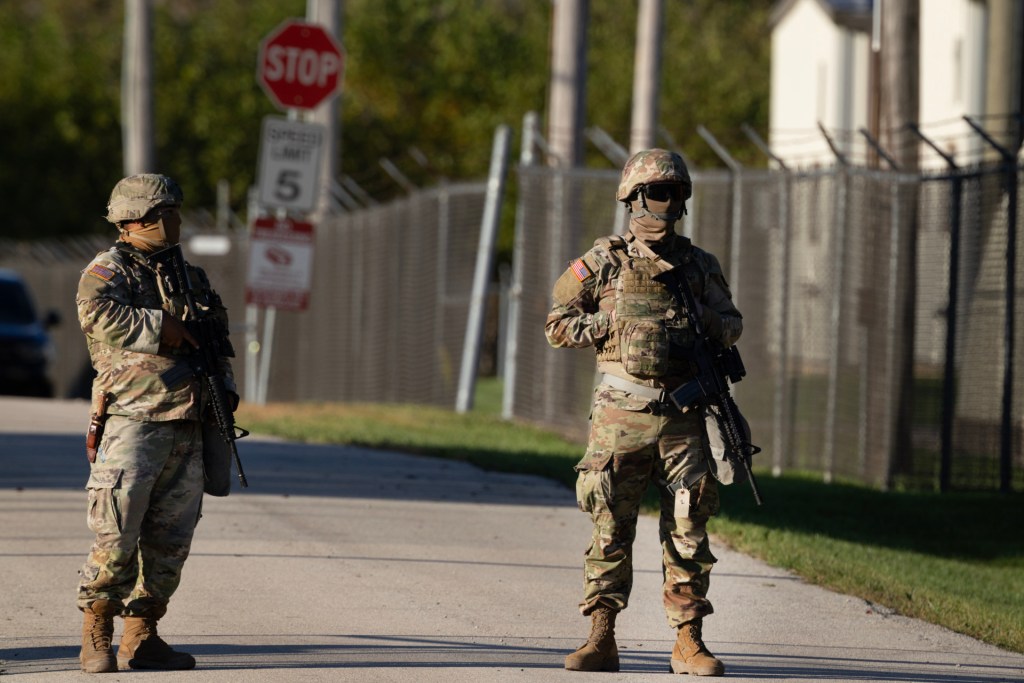
On Dec. 23, by a vote of 6-3, the Supreme Court held that President Donald Trump likely lacked authority to federalize National Guard forces to protect federal property and personnel under 10 U.S.C. § 12406(3). The ruling followed Trump’s attempt to deploy federalized National Guard forces in response to protests against Immigration and Customs Enforcement (ICE) activities in Chicago.
The decision was not based on any assessment of the conditions on the ground. Rather, six justices construed the law to permit federalization of National Guard forces only in situations where the use of active-duty armed forces was—or, possibly, would be—insufficient. Five justices opined that the president could not make such a showing under current circumstances, while Justice Brett Kavanaugh opined in his concurrence that the president simply had not made such a showing.
Following the ruling, Trump announced on social media that he would pull federalized Guard forces out of Chicago, as well as Los Angeles and Portland, Ore. (where he had also invoked 10 U.S.C. § 12406(3)) . . . for the time being. But he also promised to “come back, perhaps in a much different and stronger form,” in the future.
Legal scholars have observed that the Supreme Court’s decision leaves open two avenues for Trump to reattempt deployment of federal forces: He could deploy active-duty armed forces pursuant to a claim of inherent constitutional authority, or he could invoke the Insurrection Act to deploy either active-duty or federalized National Guard forces. While the majority decision does not expressly foreclose either of these options, however, its rationale does create significant new obstacles for them.
Background
The statute that Trump invoked in California, Oregon, and Illinois allows the president to federalize National Guard forces when, inter alia, “the president is unable with the regular forces to execute the laws of the United States” (10 U.S.C. § 12406(3)). All three states filed lawsuits arguing that this statutory criterion had not been met because civilian law enforcement had been able to manage the sporadic incidents of violence accompanying protests against ICE.
The administration argued that the president’s decision on this matter was judicially unreviewable. In the alternative, it argued that courts must extend substantial deference to the president’s judgment; that the phrase “unable . . . to execute the laws” cannot be read literally, and should instead be read to encompass significant impediments to law enforcement; and that the violent actions of some protesters were sufficient to meet this threshold.
The rulings of the courts in all three states focused largely on these questions. No court agreed with the administration that the president’s invocation of the statute was unreviewable. All three district courts held, as a factual matter, that the president was able to execute the laws without resort to the military. But the conclusions of the district courts in California and Oregon were rejected by appellate panels in the Ninth Circuit, on the ground that the district judges had not given the president sufficient deference in his assessment of the facts. The Seventh Circuit, by contrast, found no “clear error” in the district judge’s factual findings.
Throughout these lower court proceedings, the legal question that would ultimately dominate the Supreme Court’s ruling arose in only one place: the district court’s ruling in the Illinois litigation. The parties had assumed that the term “regular forces” in 10 U.S.C. § 12406(3) referred to civilian law enforcement. Judge April Perry, however, closely examined the legislative history of the statute and concluded that the term referred to the active-duty armed forces. She further determined that 10 U.S.C. § 12406(3) did not itself authorize the deployment of the active-duty military. In the absence of statutory authority, the president could deploy troops domestically only if “the civil power has failed,” and the evidence in the record did not show any such failure.
On appeal, the Seventh Circuit did not engage in the “thorny and complex” question of whether “regular forces” refers to civilian officials or active-duty armed forces. The panel found that 10 U.S.C. § 12406(3)’s condition for federalization was not met under either interpretation, as there was “insufficient evidence that protest activity in Illinois has significantly impeded the ability of federal officers to execute federal immigration laws.” And in the briefs filed with the Supreme Court, both parties continued to assume that “regular forces” meant civilian law enforcement.
After Georgetown Law professor Marty Lederman filed an amicus brief providing strong support for the district court’s interpretation, however, the Supreme Court requested additional briefing on this question from the parties. As the weeks went by without a ruling, it became clear that the Court was wrestling with legal questions far beyond the more straightforward (albeit weighty) issues of how much deference to extend to the president and whether the facts supported his assessment under the appropriate standard of review.
The Supreme Court’s Majority Ruling
The Supreme Court denied Trump’s application to stay the injunction in Illinois by a vote of 6-3. There were four separate opinions: the opinion of the Court on behalf of Justices John Roberts, Sonia Sotomayor, Elena Kagan, Amy Coney Barrett, and Ketanji Brown Jackson; a concurring opinion filed by Justice Kavanaugh; a dissent filed by Justices Samuel Alito and Clarence Thomas; and a separate dissent by Justice Neil Gorsuch.
The six justices in the majority agreed with the district court and Prof. Lederman that the term “regular forces” means the active-duty armed forces. There is, indeed, overwhelming support for this interpretation in the legislative history and contemporaneous historical documents. To be sure, this interpretation leads to a counterintuitive result: In addressing domestic disturbances, the president (at least under 10 U.S.C. § 12406(3)) must turn first to the professional, full-time armed forces, rather than summoning the local, part-time “citizen soldiers” of the National Guard. In modern times, this feels like using a Howitzer when a pistol would suffice. As Prof. Lederman pointed out, however, this order of operations made more sense in 1908, when the statute was enacted. At the time, the state militia were perceived (in the words of a leading treatise) to be “inefficient, ill led, ill equipped, and undisciplined,” and their deployment “invariably” led to “bloodshed and casualties resulted.” By contrast, the active-duty armed forces “were believed inherently nonpartisan, more reliable, and more efficient.”
In his concurrence, Justice Kavanaugh noted that, “[o]n the current record . . . it does not appear that the President has yet made the statutorily required determination that he is ‘unable’ with the U. S. military, as distinct from federal civilian law enforcement officers, to ensure the execution of federal law in Illinois.” Justice Kavanaugh would have denied the stay application on that basis alone; he saw no need to proceed any further. Of course, Trump could easily cure that procedural defect, thus restarting the entire process.
Rather than invite such delay, the five other justices in the majority squarely addressed whether Trump was “unable” to execute the laws using active-duty armed forces. As a threshold matter, they determined that, “[b]ecause the statute requires an assessment of the military’s ability to execute the laws, it likely applies only where the military could legally execute the laws.” This is a crucial point, as the administration had argued that a lack of legal authority to deploy the active-duty military would itself render the president “unable with the regular forces to execute the laws.”
The five justices then observed that the Posse Comitatus Act (PCA) prohibits using the active-duty military to execute the laws absent an express statutory or constitutional exception. Trump, they noted, had not invoked a statutory exception that would permit deployment of active-duty troops. (The opinion does not explicitly reference the Insurrection Act, but that is presumably what the justices had in mind.) The only authority the administration invoked that would permit such deployment was an “inherent constitutional authority that, according to the Government, allows [the president] to use the military to protect federal personnel and property.”
The administration did not argue that this claimed constitutional authority constitutes an exception to the PCA that allows federal armed forces to execute the law. After all, an “inherent” constitutional power cannot be an “express” exception, as required by the PCA. (Indeed, the PCA’s legislative history suggests that there are no constitutional exceptions.) Rather, relying on a Department of Justice opinion from the Nixon era, the administration argued that protecting federal property, personnel, and functions does not constitute “executing the laws,” and so the PCA simply doesn’t apply.
The five-justice majority, however, refused to let the administration have it both ways. If such protective functions do not constitute “executing the laws,” the majority reasoned, then National Guard forces cannot be federalized and deployed to perform such functions under a statute (10 U.S.C. § 12406(3)) that authorizes deployment for the purpose of “executing the laws of the United States.” In other words, either the PCA applies and would presumably bar deployment of active-duty troops, or it doesn’t apply—and, for the same reason, neither does 10 U.S.C. § 12406(3).
What Options Might (or Might Not) Remain for the Trump Administration
Deployment of Active-Duty Armed Forces Under Claimed Constitutional Authority
In theory, the majority decision does not squarely foreclose the deployment of active-duty troops under a claim of inherent constitutional authority to protect federal personnel and property, divorced from any reliance on 10 U.S.C. § 12406(3). However, the majority’s reasoning—and the administration’s own representations in the litigation—would pose significant barriers to this approach.
Significantly, the majority did not recognize that the president actually has inherent constitutional authority to deploy federal troops to protect federal property, personnel, and functions. In his “outstanding definitive treatment of the issue” (as described by Jack Goldsmith), Professor Chris Mirasola has made a strong case that there is no such inherent power. And even if one existed, Prof. Mirasola explains that it has been displaced by a comprehensive statutory framework vesting protective responsibilities in multiple civilian agencies and limiting military support for civilian government.
The majority’s opinion provides yet another reason to reject the executive branch’s claim of inherent authority. The administration asserts that this authority derives from the Take Care Clause, under which the president “shall take Care that the Laws be faithfully executed.” But the administration has also argued that federal protective functions do not constitute “executing the law.” If that is correct, the president cannot rely on the Take Care Clause for the same reason the majority ruled that he could not rely on 10 U.S.C. § 12406(3): he cannot invoke an authority to execute the law as a basis for deploying troops to do something that is not executing the law.
As noted above, the majority did not resolve whether deploying troops to protect federal property, personnel, and functions constitutes executing the law. In fact, the actions National Guard forces were authorized to perform in California, Oregon, and Illinois—actions such as security patrols, crowd control, and traffic control—would clearly constitute “executing the laws” under the PCA as interpreted by the courts. The administration, however, is unlikely to reverse its position on this question. Even if doing so would remove one hurdle to relying on the Take Care Clause (many others still remain), it would leave the administration without any serious way around the PCA.
On this point, Justices Alito and Thomas—who accept virtually every one of the administration’s arguments in their dissent—make a basic error. They express incredulity that “the Posse Comitatus Act somehow limit[s] a President’s inherent constitutional authority” (an authority that they wholeheartedly embrace). But the seminal case of Youngstown Sheet & Tube Co. v. Sawyer establishes that Congress may limit a president’s constitutional authority as long as Congress is acting within its own constitutional authority. As Prof. Mirasola has recounted, Congress plainly has authority to enact legislation regarding the protection of federal property, personnel, and functions, and it has done so—uncontroversially—through an extensive set of statutes.
Deployment of active-duty troops would face another barrier, this one political as much as legal. In its briefing before the Supreme Court, the administration argued that, while it had legal authority to deploy active-duty troops, it was “unable,” for purposes of 10 U.S.C. § 12406(3), to execute the laws in Chicago using those troops. Its reasoning is remarkable and merits reproducing in full (with internal citations deleted):
Here, the President could reasonably determine that using the standing military rather than the National Guard to protect DHS personnel and property in Illinois would significantly impede execution of the federal immigration laws because the standing military is less well suited than the National Guard to perform such protective functions on the streets of American cities. After all, the standing military’s primary function is to win wars by deploying lethal force against foreign enemies, whereas the National Guard traditionally helps to keep the peace among the citizenry during domestic disturbances. In fact, one of respondents’ own witnesses, a retired Army general, stated that soldiers in the standing army have “an aggressive mindset” because their “mission” is to “destroy the enemy,” not “try to prevent confrontation and reduce the use of lethal force.” Likewise, given the strident opposition of state and local political leaders, who are actively campaigning for DHS to leave Illinois and have compared federal agents to roving bands of violent criminals and Nazi troopers, the President could reasonably have determined that deploying the standing military would result in even more strident resistance, resulting in even more “tepid” support from state and local police. Similarly, the nature of the violent opposition encountered may have led the President to conclude that the National Guard, not the standing military, is uniquely adapted to achieve the protective mission. As violent mobs confronted ICE agents in Chicago, leading them to fear for their lives on a daily basis, the President could reasonably have determined that the members of the National Guard—with their greater local knowledge, ties to the community, and domestic focus—would be more effective than active-duty soldiers in addressing those threats.
That is a stunning concession. Not only would active-duty troops be less effective (according to the administration) in providing protective functions; they are so poorly suited to such a mission that their deployment would “significantly impede execution of the federal immigration laws.” It is difficult to see how the administration could justify deploying active-duty armed forces after such a representation. At a minimum, any such action would be even more politically fraught than it would otherwise have been.
Invocation of the Insurrection Act
The majority opinion does not address the Insurrection Act, merely noting that Trump had invoked no statutory authority to deploy active-duty troops. Trump thus retains this option, at least in theory. But here, too, the majority opinion creates a potential obstacle.
Of course, the initial question would be whether an Insurrection Act invocation is subject to any judicial review (the administration argues that it is not). The majority opinion sheds no light on whether courts could review the president’s assessment of the facts and, if so, under what standard. However, the majority’s willingness to construe the term “regular forces” strongly suggests that the Court would find no impediment to courts construing the terms of the Insurrection Act.
The Insurrection Act allows the president to deploy active-duty troops or federalized National Guard forces under circumstances set forth in three separate provisions. The first of these provisions authorizes deployment when a state requests assistance to suppress an insurrection against the state’s government. That provision clearly would not apply in California, Oregon, or Illinois.
The second and third provisions do not require an insurrection or a state request for assistance. However, while they are less direct and succinct on this point than 10 U.S.C. § 12406(3), they both contain language indicating that the purpose of any deployment under the statute is to enable execution of the law. The second provision reads:
Whenever the President considers that unlawful obstructions, combinations, or assemblages, or rebellion against the authority of the United States, make it impracticable to enforce the laws of the United States in any State by the ordinary course of judicial proceedings, he may call into Federal service such of the militia of any State, and use such of the armed forces, as he considers necessary to enforce those laws or to suppress the rebellion [emphasis added].
Similarly, the third provision provides that the president may deploy troops to suppress an “insurrection, domestic violence, unlawful combination, or conspiracy,” but only if the circumstance in question either (1) “hinders the execution of the laws of that State, and of the United States within the State” in a way that leads to civil rights deprivations, or (2) “opposes or obstructs the execution of the laws of the United States or impedes the course of justice under those laws” (emphasis added).
Both provisions thus frame deployment as a means to execute the law in the face of obstructions to such execution. Yet the administration, in seeking to insulate its claim of inherent constitutional authority from the PCA, has insisted that protecting federal property, personnel, and functions is not executing the law.
In theory, the administration could safely abandon that position when invoking the Insurrection Act, as the statute is widely understood to provide an exception to the PCA. In practice, though, it would be extremely awkward for the administration to perform such a complete reversal of its own position—and the longstanding position of the Department of Justice—before the courts. Moreover, it would undermine any concurrent or future attempts to rely on the claim of inherent constitutional authority.
The administration would no doubt argue that protective functions can be in service of executing the law even if they are not, themselves, law execution. But that same logic would apply in the context of 10 U.S.C. § 12406, which—like the Insurrection Act—references execution of the laws in describing the problem deployment is meant to solve, not the actions troops may take. The majority’s opinion makes clear that if the goal of deployment under the statute is the execution of the law, the statute does not authorize deployment for non-law-execution functions. Accordingly, if the administration sticks to the legal fiction that protective functions are not executing the law, the Court could well find that the Insurrection Act does not provide authority for them.
***
The majority opinion thus not only forecloses Trump’s reliance on 10 U.S.C. § 12406; it poses significant challenges for any future attempt to deploy active-duty troops under a claim of inherent constitutional authority or to invoke the Insurrection Act for the purpose of protecting federal property, personnel, and functions. And Justice Gorsuch’s dissent suggests a potentially even greater hurdle for the administration. Even though Justice Gorsuch would have granted the stay on the limited record before the Court, he emphasized the need for further briefing on the “sensitive and gravely consequential questions concerning what roles the National Guard and U.S. military may play in domestic law enforcement.” In particular, he posed a question that went beyond even the plaintiffs’ presentation of the issues: “When, if ever, may the federal government deploy the professional military for domestic law enforcement purposes consistent with the Constitution?”
For more than two centuries, the Court has managed to avoid confronting that question. If Trump continues to abuse the military to police protests in U.S. cities, the Court might finally be induced to answer it.