Donald Trump’s repeated public threats to seek a third term as president, if allowed to proceed, would plainly violate the 22nd Amendment, which limits a person to being elected to the presidency two times. But the Amendment’s text, purpose, and ratification history leave no ambiguity on this point.
Despite this explicit constitutional prohibition, the Trump Organization is selling Trump 2028 merchandise, including a baseball hat that the president featured in the Oval Office while meeting with congressional leaders in September. In recent weeks, Trump and several of his allies have openly suggested that a third term remains possible. Earlier this year, Steve Bannon—the chief executive of Trump’s 2016 campaign and a former White House advisor— told The Economist that Trump is going to “get a third term” and that people “just ought to get accommodated with that.” And at a news conference in the Capitol building, Speaker of the House Mike Johnson claimed that many Americans “lament” the constrictions of the Constitution, and that “the ‘Trump 2028’ cap is one of the most popular that’s ever been produced.” Trump himself admitted that he would “love” to serve a third term as president. In a recent interview, he said, “Based on what I read, I guess I’m not allowed to run,” before equivocating, “So we’ll see what happens.” Although the president and his allies have repeatedly tried to muddy the waters in recent months, the 22nd Amendment and historical record of its ratification are clear.
During the drafting of the Constitution, and over the subsequent years, Americans consistently debated whether and how to limit presidential terms. Many who lived under the thumb of King George III and through the American revolution had strong concerns about the dangers of unconstrained executive power, which, combined with the examples set by George Washington and Thomas Jefferson when each chose to eschew public office after two terms, created a strong norm that led to more than a century of presidents serving no more than two terms. Presidents of various parties observed this tradition, which was also enforced by voters and the political process when necessary through elections. As Thomas Jefferson observed in 1807, without externally imposed limits, the presidency “will in fact become for life, and history shows how easily that degenerates into an inheritance.”
The two term tradition for American presidents, while not unchallenged, remained unbroken until, during a time of major unrest that included the Great Depression and the second World War, the norm failed and President Franklin Roosevelt was elected to not three, but four terms, before dying while in office. In the wake of these events, the country confronted the question of whether it wanted this possibility to recur in the future. Despite the extreme situation that led to the breaking of the norm, the country brought to a close a 150-year debate over presidential term limits by codifying the previously unbroken two-term tradition in the strongest way possible: enshrinement in the Constitution of the United States. The legislative debate regarding what became the 22nd Amendment included not only the U.S. Congress, but also the state legislatures in 41 states, out of 48 at the time, with votes in favor cast by hundreds of legislators of both political parties. All told, the process took nearly four years.
As a review of the debates in state legislatures around the ratification of the 22nd Amendment shows, the officials who made this decision did so with not only awareness and consideration of many arguments we hear in current discourse around presidential term limits, but also with a direct experience of the alternative, in the aftermath of a second World War fought to beat back the tide of authoritarianism. Their decision deserves our continued respect, and the Constitution mandates adherence.
Support for the 22nd Amendment was Bipartisan
While one impetus for considering the 22nd Amendment was President Franklin Roosevelt, a Democrat, breaking the two-term norm, lawmakers from both parties supported the amendment and understood that it would bind presidents of each party equally. In the U.S. Congress, 47 Democratic representatives and 16 Democratic senators joined 238 Republican representatives and 43 Republican senators in supporting the measure.
Likewise in the states, the measure was supported by Democratic and Republican legislators as well as by Democratic and Republican controlled legislatures, and the legislative history confirms that these bodies well understood that it would apply to future presidents of both parties.
In Texas, for example, at the time of ratification the Texas legislature was controlled by Democratic majorities, but the measure approving the proposed amendment enjoyed strong bipartisan support. Republican Representative Edward Dicker, who voted in favor of the amendment, said,
“I’m for it 1,000 per cent. And it is going to be our handicap, because the next President will be a Republican and the 2-term limit will apply to him. But they can count on me to be for it, Republican or Democrat.”
The Joint Resolution to ratify the amendment passed the Texas House on February 20, 1951 by a bipartisan vote of 122 to 22 (with 5 absent), and the measure passed the Texas Senate on February 22, 1951 by a vote of 25 to 4 (with 2 absent).
Nevada was the 36th state to ratify the proposed amendment, officially bringing it across the three-fourths threshold to become part of the Constitution. As the Nevada State Journal reported, the Republican-controlled Nevada Senate gave “lifelong Democrat” Senator John Robbins the privilege of making the motion to ratify the amendment and to consider it as an emergency measure for approval. Senator Robbins said at the time:
“Some have given the measure the stigma of partisan politics. To me there is no such stigma. As a Democrat, active in Nevada Democratic circles for more than 40 years, I’d like to remove that stigma. I consider it a real honor that this Republican controlled Senate has picked me to make the motion to ratify the 22nd Amendment.”
On February 26, 1951, the Nevada Assembly voted to pass the resolution ratifying the 22nd Amendment 29 to 12, including nine Democrats. Later that day, in a bipartisan vote, the Senate ratified the amendment by a margin of 16 to 1.
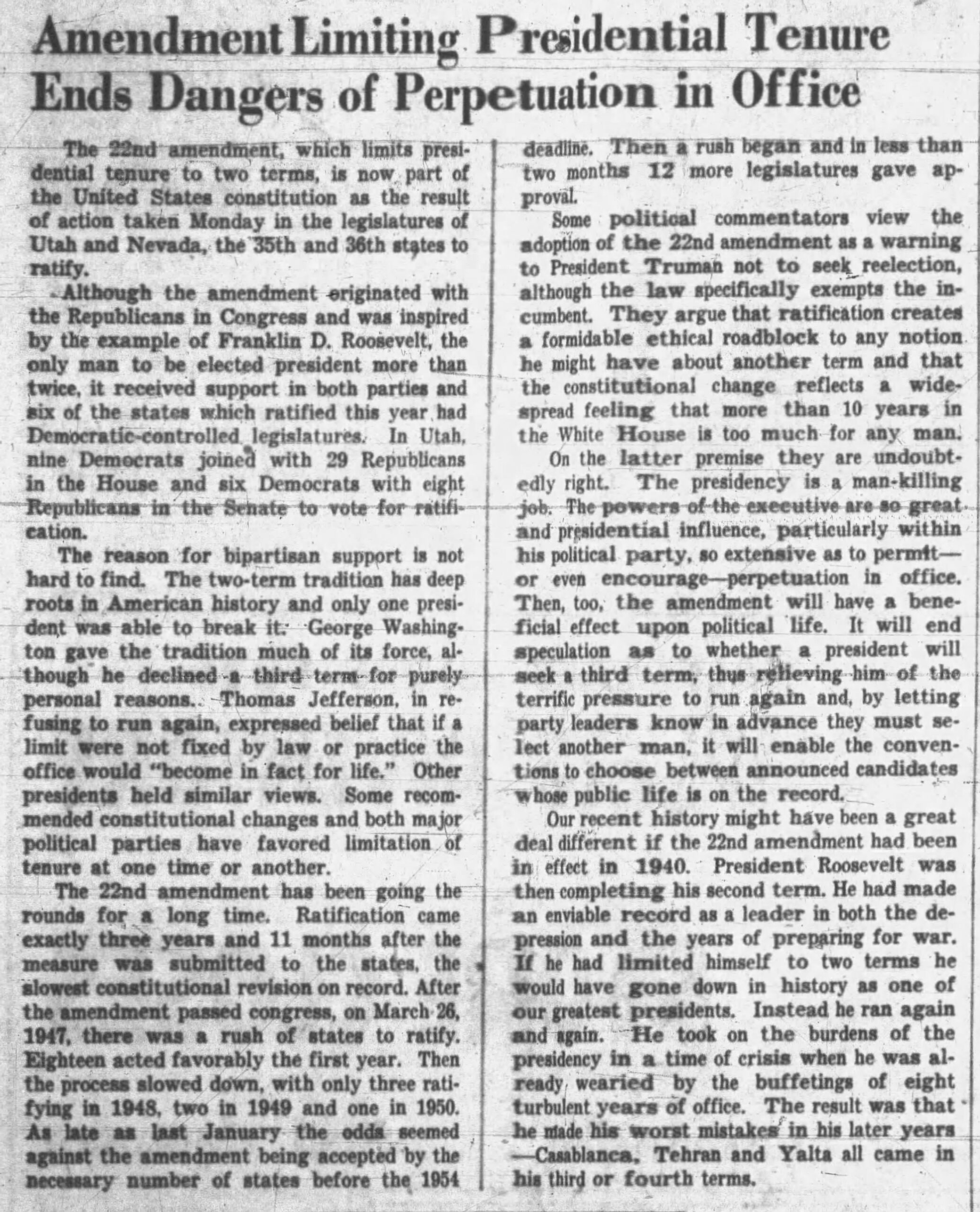
Following ratification by the requisite 36 states, the editorial page of The Salt Lake Tribune noted that although the amendment arose in response to President Franklin Roosevelt’s reelections, it “received support in both parties [including Utah] and six of the states which ratified [in 1951] had Democratic-controlled legislatures.” The editorial board explained,
“The reason for bipartisan support is not hard to find. The two-term tradition has deep roots in American history and only one president was able to break it. … [The amendment] will end speculation as to whether a president will seek a third term, thus relieving him of the terrific pressure to run again and, by letting party leaders know in advance they must select another man.”
Supporters Understood that the 22nd Amendment Would Limit the Public’s Choice
Like all qualification requirements in the Constitution, such as those setting age and citizenship requirements, the two-term limit operates as a limit on the public’s choice. Opponents of the amendment highlighted this, arguing that limiting public choice was inappropriate.
Pennsylvania Senator Burton Tarr, a Democrat, argued the amendment questioned “whether or not we believe our American form of democracy has been a success.” Senator Tarr argued the amendment suggests “the American people can not be trusted to wholly or wisely decide on the question of their Chief Executive” and claimed “[i]n one hundred and sixty years America has never had a bad president, a president of whom we could say he was dangerous to our form of government.” Senator Bertram Frazier, a Republican, took a different view, stating in support of the amendment: “I do not think it is an attempt to take away from the people the right to act; I think this gives them the right to act.” Ultimately, the Joint Resolution passed the Pennsylvania House on April 15, 1947, by a vote of 162 to 35 with 8 representatives not voting, and passed the Pennsylvania Senate on April 29, 1947, by a vote of 33 to 16.
Legislators elsewhere also rejected this argument, echoing Thomas Jefferson’s concerns about presidencies without limits. In Connecticut, Republican Representative George Ramsey said the amendment was a “forward-looking piece of legislation, aimed at no one.” He warned, “There is no indispensable man, and if that fallacy arises, there is the end of our Republic.” In South Carolina, Senator Edward Williams Cantwell, a Democrat, said of the 22nd Amendment debate, “no man is indispensable.”
Supporters Understood that the 22nd Amendment Would Apply Even in Times of Emergency
The question of whether it is wise to require a change in administration notwithstanding the fact that the country could be in the grips of an emergency at the time was also part of the debate in some states.
In Wisconsin, Republican Senator Ernest Heden, who supported the amendment, noted that an emergency rationale for staying in office could be abused. He said a president might conceivably “build himself up” through broad powers and “create emergencies himself” that would force the people to continue him in office. “There are men in this world who would capitalize on economic conditions and other catastrophes in order to exalt their own power.”
Illinois Senator Roland Libonati, a Democrat, “argued that future emergencies could arise and that the individual voter shouldn’t be restricted in his choice of a President.” These arguments were ultimately rejected by the Illinois legislature, as both chambers approved the Amendment by significant margins.
Pennsylvania Senator Carleton Woodring, a Democrat, argued the amendment was “a shame, … a travesty on our democratic principles, … a bad piece of legislation” because it would prevent future generations from exercising “the democratic right to govern themselves,” particularly in the situation of “great national emergency by reason of war, or by reason of internal strife, for one reason or another, or by reason of great economic difficulties.” As noted above, the Pennsylvania legislature also approved the amendment by significant margins.
Supporters Wanted to Prevent a Demagogue from Abusing Presidential Power
Legislators also acknowledged that because presidents in our constitutional system have significant power, they can abuse it to keep themselves in power.
South Carolina Senator John C. Taylor, a former Democratic member of Congress, reportedly “[led the] battle for [the] two-term limit” in South Carolina; Taylor expressed concern that an incumbent president’s control of political party funds would ensure that nominating conventions were “controlled from the top and not from the grass roots.”
Illinois Representative Clinton Searle, a Republican, said in support of the amendment, “The late Franklin D. Roosevelt overrode the unwritten law of our land. We want to reestablish that law so that some future demagog [sic] can’t use burocratic [sic] controls to establish a dictatorship and political dynasty.”
Similarly, Texas Representative Samuel Jackson Isaacks, a Democrat known as dean of the Legislature, said, “The Constitution is written to see to it that our public officers do not have too much power. Any President, by force of patronage, can renominate himself. The President appoints every federal judge, every district attorney, and indirectly every postmaster. They are responsible to him for bread and meat. When a man can renominate himself through patronage, he may also be re-elected through patronage. That’s not democratic. It resembles dictatorship.”
* * *
The day after the 22nd Amendment was ratified in New Hampshire, the Nashua Telegraph noted that even despite the vote along party lines in that state’s legislature,
“Conceivably the Republicans may some day come up with a man with the vote getting appeal of the late President Roosevelt who might want to continue in office indefinitely. This amendment prohibits such ambition as it should. No man should hold office in perpetuity no matter how much he may appeal to the electorate as a candidate. The United States has grown great and strong under many Presidents. There is no reason why this policy should not continue.”
To violate the 22nd Amendment would be to discard the wisdom of those who sought to preserve our democracy against the last rising tide of authoritarianism, and who foresaw the possibility we now find ourselves in. The 22nd Amendment resolves this question definitively. Its prohibition is binding constitutional law borne out of the rigorous ratification process, not a matter of political preference, to be decided in a partisan election.