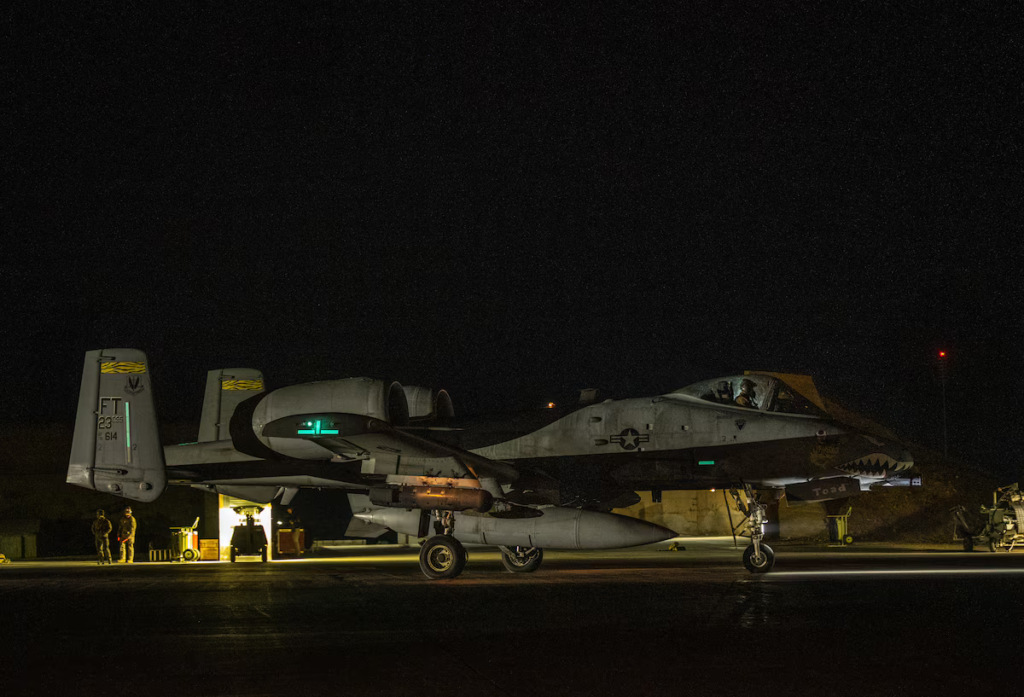
On Friday, the United States launched Operation Hawkeye Strike against ISIS in Syria. U.S. aircraft and artillery struck more than 70 targets with over 100 precision munitions. The Royal Jordanian Air Force also participated in the operation, which was in part a response to a Dec. 13 attack on U.S. and Syrian personnel that killed three Americans, two soldiers and a civilian interpreter. Since their deaths, U.S. and partner forces in Syria have now conducted 10 operations in Syria that reportedly resulted in the deaths or detention of 23 ISIS fighters.
According to the CENTCOM Commander, Admiral Brad Cooper, Operation Hawkeye Strike was “critical to preventing ISIS from inspiring terrorist plots and attacks against the U.S. homeland … We will continue to relentlessly pursue terrorists who seek to harm Americans and our partners across the region.” CENTCOM pointed out that this is a continuation of a campaign in which “U.S. and partner forces in Syria have conducted more than 80 operations over the last six months to eliminate terrorists posing a direct threat to the United States and regional security.”
Following the operation, both President Donald Trump and Secretary Pete Hegseth took to social media. On Truth Social, Trump announced that “the United States is inflicting very serious retaliation, just as I promised, on the murderous terrorists responsible.” He continued, “All terrorists who are evil enough to attack Americans are hereby warned — YOU WILL BE HIT HARDER THAN YOU HAVE EVER BEEN HIT BEFORE IF YOU, IN ANY WAY, ATTACK OR THREATEN THE U.S.A.” For his part, Hegseth used X to warn, “This is not the beginning of a war — it is a declaration of vengeance. The United States of America, under President Trump’s leadership, will never hesitate and never relent to defend our people.”
Syria appears supportive of Operation Hawkeye Strike. In his Truth Social post, for example, Trump stated that “the Government of Syria … is fully in support.” Following the attacks, Syria’s Ministry of Foreign Affairs appeared to confirm the President’s claim. After offering condolences to victims’ families, it stated on X that “this tragic loss underscores the urgent necessity of strengthening international cooperation to combat terrorism in all its forms.” The post continued,
The Syrian Arab Republic reiterates its steadfast commitment to fighting ISIS and ensuring that it has no safe havens on Syrian territory, and will continue to intensify military operations against it wherever it poses a threat.
The Syrian Arab Republic invites the United States and member states of the international coalition to support these efforts in a manner that contributes to the protection of civilians and the restoration of security and stability in the region.
Syria remains an active battlefield, with ISIS fielding, by some estimates (others are lower), as many as 5,000 to 7,000 fighters in Iraq and Syria. Fighting between ISIS and the new Syrian regime has been intense since the latter gained power in March. Also engaging ISIS is the U.S.-led Combined Joint Task Force Inherent Resolve, which acts as the military component of the broader Global Coalition to Defeat ISIS.
On Nov. 11, the day after Syrian President Ahmed al-Sharaa traveled to the United States to meet with President Trump, Syria joined the Global Coalition, bringing the membership to 90. Military cooperation in the fight against ISIS began even earlier, for instance, with the United States sharing intelligence on ISIS with Hayʼat Tahrir al-Sham, which overthrew former President Bashar al-Assad’s regime. Since then, there have been regular joint operations between Coalition forces and Syrian security forces against ISIS.
The statements by Trump and Hegseth, as well as earlier ones, have sparked a behind-the-curtain discussion among international law experts over whether Operation Hawkeye Strike complied with the international law restrictions on the use of force set forth in the jus ad bellum. These are found principally in the UN Charter’s Article 2(4) prohibition on the use of force against other States and Article 51’s right of self-defense in the face of an “armed attack.” In this article, we explain why the operation was lawful, as would be future such operations by U.S. and Coalition forces against ISIS. In our estimation, there are two independently viable justifications for these and any such follow-on strikes.
Retaliation, Vengeance, and Deterrence
Before turning to the grounds on which Operation Hawkeye Strike can be legally justified, it is first necessary to address the Trump and Hegseth posts, because they raise the issue of the motivation for using force under international law. States and their citizenry often harbor a desire for retaliation, reprisal, vengeance, punishment, and the like. Indeed, their leaders typically vow to act, or claim to have acted, as Trump and Hegseth have, on those bases. It would be naive to deny that many, if not most, forcible responses to attacks are in fact motivated by just such emotions. But to be clear, there is no basis in international law for acting on them as such. In other words, a response may be based on a desire to strike back for these reasons, but there must be a separate basis in international law for conducting the operation.
Deterrence is slightly more nuanced. Although States will often rhetorically claim to be using force to deter an attack, there is no right in international law to do so. In other words, a mere threat of an attack does not trigger a legal right to act forcibly to prevent it. For instance, a potential adversary’s acquisition of the capability to mount an armed attack does not open the door to taking forcible action against that capability. Nor does a desire to use force to affect the will of an adversary that might be considering an attack.
Of course, deterrence often motivates actions that are otherwise lawful. In the law of self-defense, States facing an “imminent armed attack” may use force to prevent that attack by striking first, including by mounting forcible actions that deter the attacker from deciding to execute it. We hasten to add that disagreement exists over when the right to anticipatory self-defense is triggered (one view involves a “last window of opportunity” approach, while other views focus more on temporal proximity). Whatever the correct interpretation, forcibly deterring an attacker from carrying out the attack is clearly lawful once an attack is imminent (some might call it “repelling” rather than “deterring” an imminent attack).
Force motivated by deterrence can also be lawful following an action qualifying as an armed attack. If the attack was a one-off and unlikely to be repeated, any forcible action against the attacker would be mere retaliation or punishment. However, as we have argued, if the victim state reasonably concludes that the attack is but the first in a “campaign” against it, it may employ force to persuade its attacker to desist (see Schmitt, Goodman, and Ruys) . Although there is a risk that the victim State will mistakenly conclude that further strikes by its attacker will occur, it is reasonable for the attacker to bear the risk of miscalculation, so long as the victim State’s conclusion that it has suffered only the first (or the next) in a series of attacks is reasonable in the circumstances.
The point is that, like retaliation and vengeance, deterrence, as such, provides no independent basis for using force during Operation Hawkeye Strike or any other resort to force.
Assistance to Syria
In international law, one State may come to the assistance of another to engage in law enforcement activities or to conduct hostilities during an international or non-international armed conflict (Paramilitary Activities, ¶ 246). Such assistance may only be afforded based on the consent of the State receiving it, a point reflected in the International Law Commission’s recognition of consent as a customary law “circumstance precluding wrongfulness” in its Articles on State Responsibility (art. 21). The same is true when the assisting State is acting in collective defense of the other State (Paramilitary Activities, ¶ 199) under Article 51 of the UN Charter, because collective self-defense is always conditioned on a request from the State facing an armed attack. And with respect to consent, the al-Sharaa government is the proper source of authority for Syria, even though it took power by force; that’s due to the effective control doctrine under international law.
Syria and ISIS are undeniably involved in a non-international armed conflict. As accurately noted by the Geneva Academy’s War Watch project, “the frequency, organization, and sophistication of the attacks involving Islamic State and the Syrian government remain sufficient to satisfy the intensity threshold under IHL.” This being so, the Syrian government may request assistance in that fight from other States, which it has done by joining the Global Coalition.
The nature and scope of any assistance provided is strictly limited to that consented to by Syria. Thus, even though Syria has consented to the presence of Coalition forces and their counter-ISIS operations in general, it could impose limits on those operations, including requiring pre-approval for missions. Open-source material does not provide sufficient detail to definitively determine that Operation Hawkeye Strike fell within the parameters of Syrian consent. However, given the apparent lack of Syrian objection to any of them and Syria’s supportive statements, it would appear that they do. In this regard, it must be cautioned that while consent may be explicit or implied, mere acquiescence in the face of a Hobson’s choice is not consent. Yet the Ministry of Foreign Affairs’ post, appearing on the same day as the U.S. strikes, clearly signals implied (almost explicit) consent, even if after the fact.
Finally, not only are the operations such as Hawkeye Strike conditioned on the consent of Syria as the assisted State, but international law also constrains them. To begin with, only operations that Syria would be entitled to engage in may be conducted by its Coalition partners, since the latter’s authority to act derives from the former’s. It is indisputable that Syria may use force against ISIS or any other armed group to maintain domestic order. And since the level of violence between Syria and ISIS has reached the level of a NIAC, the law of armed conflict applicable to such situations governs the operations of both sides. Thus, Coalition forces would be entitled to engage in operations permitted by the body of law, such as status-based targeting, but would also be subject to restrictive rules, such as proportionality and the prohibition of indiscriminate attacks. The Operation Hawkeye Strike targets appear to have been classic military objectives under the law of armed conflict, and there is no indication that U.S. or Jordanian forces violated any of its prohibitions or restrictions.
U.S. Unilateral Self-Defense
The origins of hostilities between U.S. forces and ISIS are twofold. First, ISIS’s predecessor, Al Qaeda of Iraq, arose in armed response to the 2003 U.S. intervention in that country. Hostilities later occurred in the context of ISIS operations against Iraq in 2014, with the United States assisting Iraq in collective self-defense by conducting operations against the group, including, at Iraq’s request, ISIS targets in Syria. That effort led to the establishment of Operation Inherent Resolve.
Soon after the United States began assisting Iraq against ISIS, the group started targeting U.S. forces and U.S. citizens, including journalist James Foley, in a manner unrelated to the Iraq-ISIS conflict. Those attacks continued unabated even after ISIS lost control, in 2019, of the territory it had conquered. The Dec. 13, 2025 attack that killed the three Americans is only the most recent. (see Tom Joscelyn’s assessment, in Just Security, of the continuing ISIS threat in 2024 and 2025.)
The United States is of the view that States enjoy a right of self-defense against non-State actors, and rightfully so (DoD Law of War Manual, § 1.11.5.4). It is on this basis that it has long justified actions against non-State groups in Syria as an exercise of self-defense under Article 51 of the UN Charter (e.g., see Ambassador Samantha Power’s letter to the UN in 2014; and see here). It must be acknowledged, however, that the extension of self-defense to attacks by non-State actors is not a universally held position (see Haque; Hakimi; Armed Activities, para. 146; and Wall, para. 139).
An exercise of the right of self-defense must comply with the universally accepted criteria of necessity and proportionality (Paramilitary Activities, paras. 194, 237; Nuclear Weapons, para. 41; Oil Platforms, paras. 43, 73-74, 76). The criterion of necessity provides that force may be used only when there are no viable non-forcible means to address an imminent or ongoing armed attack, including a campaign consisting of multiple related operations. That criterion is clearly met with regard to Operation Hawkeye Strike, as there is no plausible suggestion that negotiations or other non-forcible actions can convince ISIS to end its attacks on U.S. assets. Moreover, necessity has a temporal element as well in the sense that the need to use force must be present at the time of the strike. That requirement is met because, as explained above, the right to self-defense exists throughout a campaign of related attacks, which is the case in the repeated ISIS attacks on U.S. forces and assets. The necessity criterion is plainly satisfied.
Whereas necessity is about whether force may be resorted to, the criterion of proportionality limits the degree of force used in self-defense to that which is required in the circumstances to put an end to the armed attack. In this case, Operation Hawkeye Strike dealt a powerful blow against ISIS capabilities that the group could use to continue attacking U.S. forces and other American assets and individuals. However, the attacks did not exceed the proportionality threshold, for it is implausible that the 70 strikes destroyed ISIS’s capability to mount further attacks.
Even though, in our view, the United States has a clear right to use force against ISIS in self-defense, it still needs an international law basis for conducting operations in Syria, lest it violate that State’s sovereignty or, perhaps, also violate the UN Charter’s Article 2(4) prohibition on the use of force against other States. In this regard, the DoD Law of War Manual states, “Military action in the territory of another State is not a violation of Article 2(4)’s prohibition against the use of force against that State where it consents to such military action” (§ 1.11.4.3). The fact that the new Syrian government has allowed U.S. forces to remain in the country and continue to mount operations on that basis is strong evidence of Syrian consent to the U.S. exercise of self-defense against ISIS on Syrian territory. Moreover, the earlier discussion of consent in the context of assistance to Syria would apply equally here.
Because of this consent, Operation Hawkeye Strike and other related operations do not raise the specter of the so-called “unwilling or unable” approach to self-defense, according to which a State may engage in self-defense on the territory of another State that will not or cannot put an end to a non-State actor’s armed attack from its territory. Although the United States has long accepted the doctrine (see also Schmitt) and has previously proffered it to justify operations in Syria, it remains controversial (DoD Law of War Manual, §17.18.2). But unless Syria decides to begin limiting U.S. operations against ISIS in a way that leads the United States to conclude it may not effectively defend itself, that doctrine will remain dormant vis-à-vis operations in Syria.
Finally, although it does not bear on the right to resort to force in the first place under the jus ad bellum, the United States is presently engaged in a non-international armed conflict with ISIS, a characterization supported, for instance, by the Geneva Academy’s War Watch project. Applying the well-accepted Tadic criteria of organization and intensity for the existence of such conflicts (¶ 562), ISIS remains well-organized militarily; the conflict, which has raged for a period measured in years, is protracted; and the recent round of hostilities is just another reminder that the requisite level of intensity has been reached. This being so, the law of armed conflict is the applicable legal regime for U.S. and ISIS operations. As noted, the Operation Hawkeye Strike attacks appear to have been executed in compliance with that body of law.
Concluding Thoughts
In sum, Operation Hawkeye Strike fits neatly into the normative architecture of the law governing the use of force, the jus ad bellum. First, it may be treated as a form of military assistance to Syria in support of its non-international armed conflict with ISIS. Second, the operation can be characterized as an appropriate exercise of unilateral national self-defense under Article 51 mounted on Syrian territory with the consent of that State.
This case demonstrates that where a territorial State affirmatively consents and cooperates, the legal analysis with respect to other States operating there is relatively straightforward, even in the face of a complex situation on the ground. It also underscores the importance of distinguishing the formal legal basis for a use of force from the motivations that often accompany it in public discourse. Despite the rhetorical framing of Operation Hawkeye Strike in terms of retaliation and vengeance by President Trump and Secretary Hegseth, and the more generalized appeals to deterrence, the episode demonstrates that international law provides a satisfactory legal foundation for future U.S. and Global Coalition military activity in Syria.


